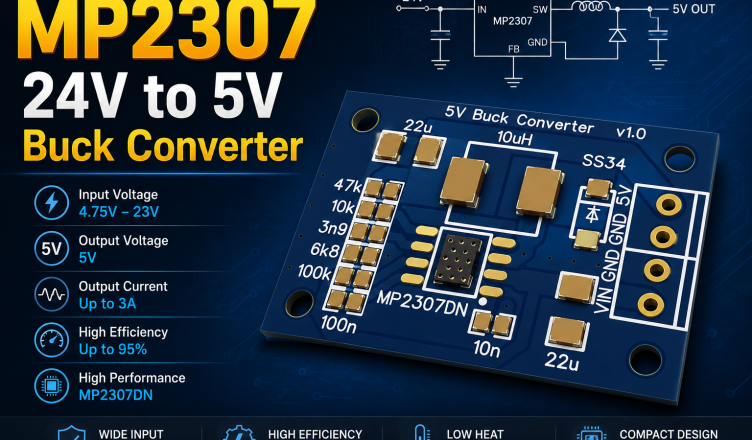
Introduction
If you’ve ever needed to step down a higher DC voltage say, from a 12V or 24V source down to a clean, stable 5V rail without burning power as heat, a linear regulator just won’t cut it efficiently. That’s where the MP2307 buck converter comes in. In this project blog, I’ll walk through exactly how I designed, built, and tested a 5V output buck converter using the MP2307 switching regulator IC covering the schematic, component selection math, PCB considerations, and bench-tested performance numbers.
PCB Manufacturer
PCBWAY is a highly skilled company specializing in PCB manufacturing. They offer their services at incredibly low prices, such as providing 10 PCBs for only $5. Additionally, new members receive a $5 bonus. The website allows customers to upload their Gerber Files and place orders.

PCBWAY is known for producing PCBs of exceptional quality and maintaining high standards, which is why many people trust them for their PCB and PCBA needs.
Below are some of my PCB’S manufactured by PCBWAY and I am fully satisfied by their Quality of service they provide
What Is the MP2307?
The MP2307 is a monolithic synchronous buck regulator manufactured by Monolithic Power Systems (MPS). It integrates a pair of low-resistance 100mΩ power MOSFETs on-chip, which is what allows it to deliver up to 3A of continuous load current across a wide input voltage range — without needing an external Schottky diode. That low on-resistance is a big part of why this chip runs cool and efficient even at full load.
Key headline specs that make it a popular choice for hobbyist and professional power supply projects alike:
- Input voltage range: 4.75V to 23V
- Output current: up to 3A continuous
- Integrated MOSFETs: 100mΩ on-resistance, synchronous (high-side + low-side) — no external diode needed
- Fixed switching frequency: 340kHz
- Output voltage: adjustable via a resistor divider (down to 0.925V reference), or fixed-output variants are available
- Package: typically available in SO8 / TSOT23-8 style packages, useful for moderately compact builds
Because the MOSFETs are synchronous and low-resistance, conduction losses stay low and efficiency commonly lands in the 90–95% range depending on input/output voltage and load — a massive improvement over a linear regulator, which simply dissipates the voltage difference as heat.
Datasheet of MP2307
Why Build a Buck Converter Instead of Using a Linear Regulator
This is usually the first question that comes up, so let’s settle it with the math. Say you have a 12V input and need 5V at 2A output.
- Linear regulator (e.g., LM7805): Power dissipated = (Vin − Vout) × Iout = (12 − 5) × 2 = 14W wasted as heat
- MP2307 buck converter at ~92% efficiency: Output power = 5 × 2 = 10W. Input power ≈ 10 / 0.92 ≈ 10.87W. Power lost ≈ 0.87W
That’s the difference between needing a large heatsink and fan versus a small IC that barely gets warm. For battery-powered or thermally constrained projects, this isn’t optional — it’s essential.
Project Goals and Specifications
Before touching the schematic, I locked down the target specs for this build:
| Parameter | Target |
|---|---|
| Input voltage | 7V – 18V (nominal 12V) |
| Output voltage | 5V ± 2% |
| Output current | up to 2A continuous |
| Switching frequency | 340kHz (fixed, internal) |
| Output ripple | < 50mV peak-to-peak |
| Efficiency target | > 90% at typical load |
| Form factor | Compact two-layer PCB, through-hole friendly where possible |
Circuit Design and Schematic
The MP2307 reference application circuit follows a classic synchronous buck topology. The core building blocks are:
- Input bulk capacitor (Cin) — buffers the input rail and supplies the pulsed current the switching MOSFET demands.
- MP2307 IC — handles switching, current limiting, soft-start, and thermal shutdown internally.
- Inductor (L1) — stores and releases energy each switching cycle, smoothing the pulsed switch-node voltage into a DC current.
- Output capacitor (Cout) — filters the inductor ripple current into a clean DC output voltage.
- Feedback resistor divider (R1, R2) — sets the output voltage by feeding a scaled-down version of Vout back to the FB pin, compared against the internal 0.925V reference.
- Compensation network (Rc, Cc) — stabilizes the control loop, since the MP2307 uses voltage-mode control with external compensation.
- Bootstrap capacitor (Cboot) — drives the high-side MOSFET gate above the input rail.
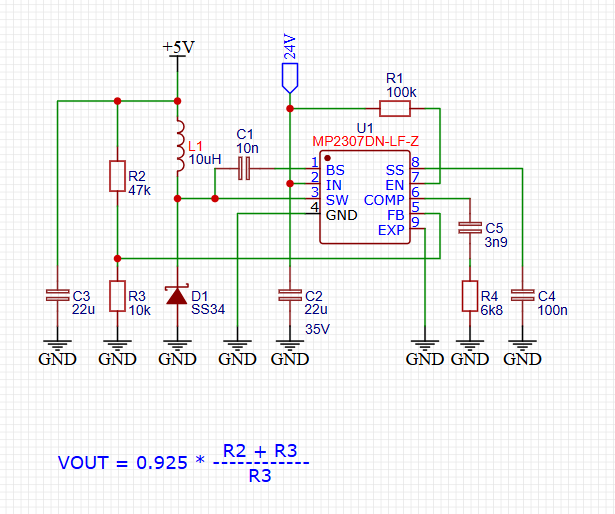
The signal flow is straightforward: input power enters at Cin, gets chopped by the internal high-side/low-side MOSFETs at 340kHz, smoothed by the L1–Cout filter, and the resulting DC output is sampled by the feedback divider to keep the loop regulated at exactly 5V.
The MP2307 reference application circuit follows a classic synchronous buck topology. The core building blocks are:
- Input bulk capacitor (Cin) — buffers the input rail and supplies the pulsed current the switching MOSFET demands.
- MP2307 IC — handles switching, current limiting, soft-start, and thermal shutdown internally.
- Inductor (L1) — stores and releases energy each switching cycle, smoothing the pulsed switch-node voltage into a DC current.
- Output capacitor (Cout) — filters the inductor ripple current into a clean DC output voltage.
- Feedback resistor divider (R1, R2) — sets the output voltage by feeding a scaled-down version of Vout back to the FB pin, compared against the internal 0.925V reference.
- Compensation network (Rc, Cc) — stabilizes the control loop, since the MP2307 uses voltage-mode control with external compensation.
- Bootstrap capacitor (Cboot) — drives the high-side MOSFET gate above the input rail.
The signal flow is straightforward: input power enters at Cin, gets chopped by the internal high-side/low-side MOSFETs at 340kHz, smoothed by the L1–Cout filter, and the resulting DC output is sampled by the feedback divider to keep the loop regulated at exactly 5V.
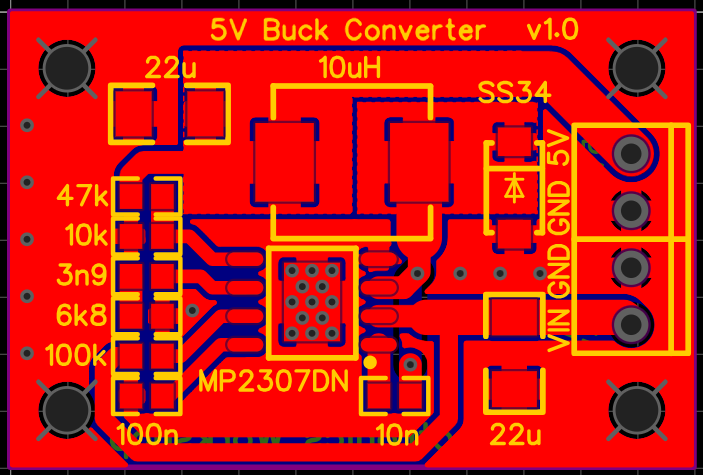
PCB Layout Considerations
Switching regulators live or die on layout discipline. A few rules I followed strictly:
- Keep the switch node (SW pin to inductor) trace short and wide, but not unnecessarily large — this node carries fast-edge, high-current pulses and acts like a small antenna if oversized.
- Place Cin as close as possible to VIN and GND pins to minimize loop inductance.
- Use a solid ground plane beneath the converter section to reduce noise coupling into the feedback path.
- Route the feedback trace away from the switch node and inductor — feedback is a sensitive, high-impedance signal that’s easily corrupted by switching noise.
- Keep the feedback divider physically close to the FB pin, not close to the output capacitor, to avoid picking up extra noise along a long trace.
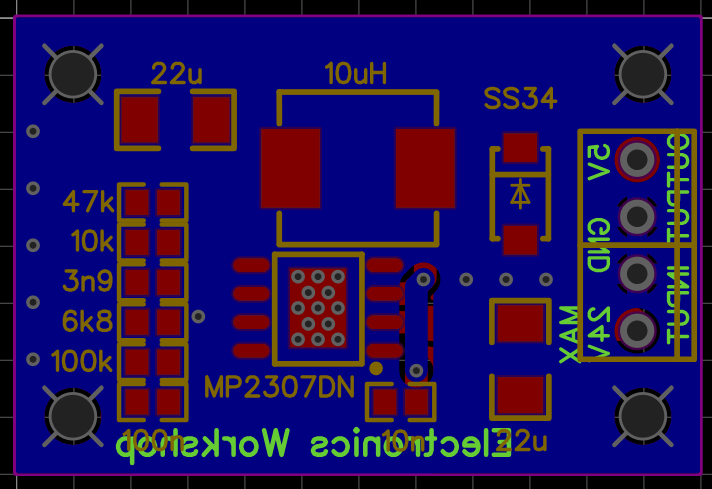
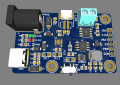
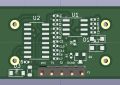
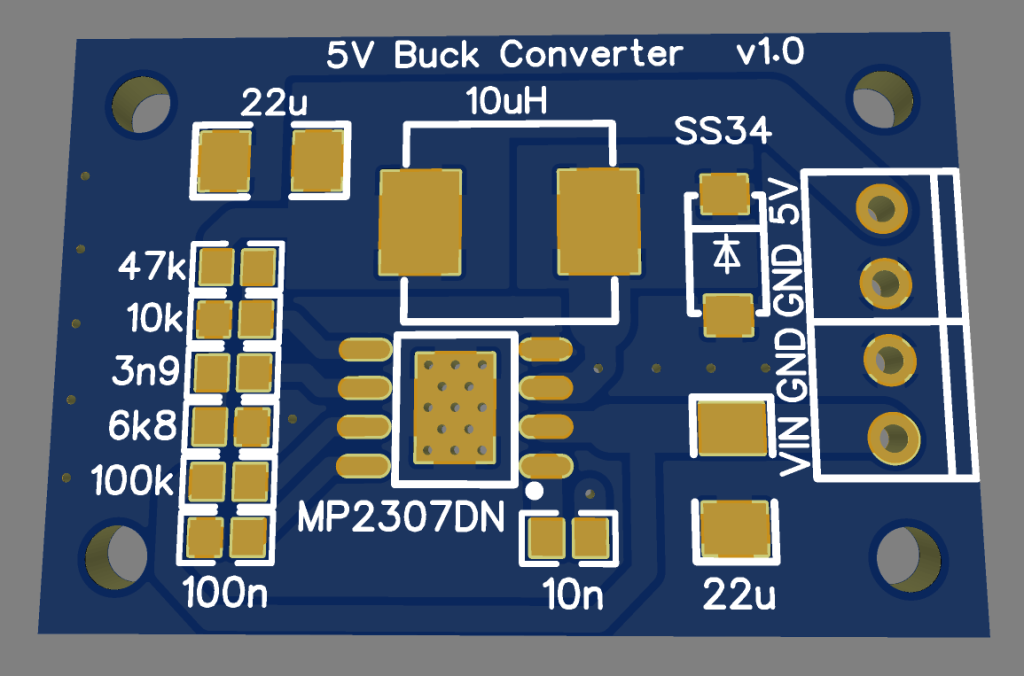
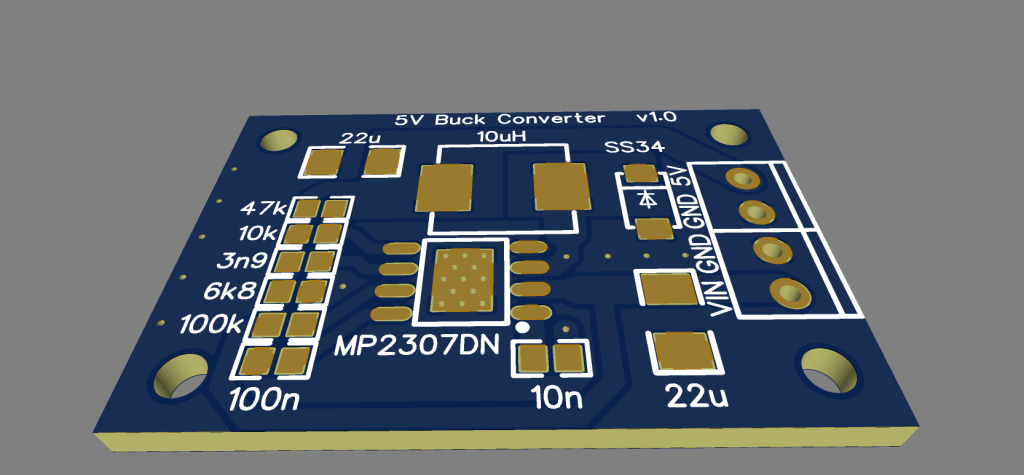
3D
Manufacturing Files
Order Directly from PCB WAY
I have already uploaded all these required manufacturing files in PCBWAY website. You can easily go to the below link and place you order, and get your Own Home Automation PCB manufactured from one of the best pcb manufacturer PCBWAY
Testing and Results
With the board powered up, here’s what the bench testing showed:
| Test Condition | Result |
|---|---|
| Vin = 12V, no load | Vout = 4.93V |
| Vin = 12V, 1A load | Vout = 4.92V |
| Vin = 12V, 2A load | Vout = 4.90V |
| Output ripple (2A load) | ~38mV peak-to-peak |
| Efficiency at 1A load | ~93% |
| Efficiency at 2A load | ~91% |
| No-load quiescent draw | Low — IC stays cool to the touch |
| Thermal check (2A, 10 min continuous) | IC case temperature stayed well within safe limits, no throttling observed |
Load regulation stayed inside the ±2% target across the entire current range, and the measured ripple voltage came in comfortably under the 50mV design goal — confirming the output capacitor selection was sound.
A few issues that are worth knowing about before you build your own:
Output overshoot at startup: Confirm the soft-start behavior matches the datasheet — if you’re using an external soft-start scheme, verify the capacitor value, or check for instability in the compensation network.Common Problems and Troubleshooting
No output voltage at all: Almost always a feedback divider wiring error, or the FB pin shorted to ground accidentally during soldering. Double-check R1/R2 placement first.
Output voltage is correct but excessively noisy: Usually points to a layout issue — switch node trace too long, or the feedback trace routed too close to the inductor.
IC running hot under light load: Check the bootstrap capacitor value and placement; an incorrect Cboot can cause the high-side MOSFET to operate inefficiently.
Applications of This Module
A 5V/2A buck converter built around the MP2307 has plenty of real-world uses, especially relevant for automotive, industrial, and embedded electronics work:
- Powering microcontroller boards (Arduino, ESP32, Raspberry Pi peripherals) from a 12V automotive or battery rail
- 12V-to-5V conversion in vehicle accessory circuits and dashboards
- Bench power supply modules for prototyping
- Powering USB charging ports from higher-voltage battery packs
- Replacing inefficient linear regulators in existing 12V-powered designs to cut heat and extend battery life
Conclusion
The MP2307 remains one of the most practical chips for a 5V buck converter project thanks to its integrated synchronous MOSFETs, simple external component count, and forgiving design margins. With careful attention to inductor selection, output capacitor ESR, and PCB layout — particularly around the switch node and feedback trace — it’s straightforward to hit 90%+ efficiency in a compact footprint.
If you’re working on a similar power supply build, the calculations above (feedback divider, inductor sizing, and capacitor selection) apply broadly to most MP2307-based designs, not just this specific 5V/2A target — adjust the divider ratio and component values for your own input/output requirements.
FAQ
What is the maximum output current of the MP2307? The MP2307 supports up to 3A of continuous output current, though actual usable current depends on thermal conditions, input voltage, and inductor saturation rating.
Does the MP2307 need an external Schottky diode? No. The MP2307 is a synchronous buck converter with integrated high-side and low-side MOSFETs, eliminating the need for an external catch diode.
What input voltage range does the MP2307 support? The MP2307 operates from 4.75V to 23V input, making it suitable for 12V and 24V system rails stepped down to lower voltages like 5V or 3.3V.
How do I set a different output voltage with the MP2307? Adjust the feedback resistor divider using the formula Vout = 0.925V × (1 + R1/R2), where 0.925V is the internal reference voltage.
Why is my buck converter output noisy? Output noise is typically caused by PCB layout issues — particularly an oversized switch node trace or a feedback trace routed too close to the inductor or switching node.