Introduction
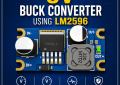
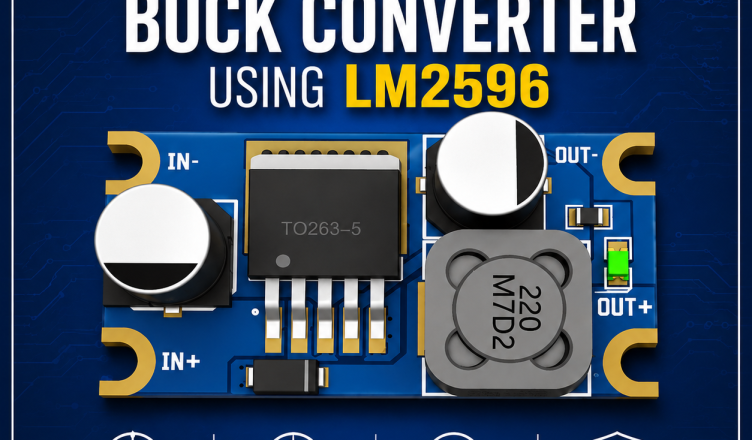
If you need to convert 12V, 24V, or any higher DC voltage into a stable 5V output, the LM2596 Buck Converter is one of the most reliable and efficient solutions available. Unlike linear voltage regulators, the LM2596 uses switching technology to achieve efficiencies of up to 92%, making it ideal for Arduino, ESP32, Raspberry Pi, robotics, IoT devices, automotive electronics, and battery-powered projects.
In this comprehensive guide, you’ll learn how the LM2596 works, its specifications, advantages, circuit operation, applications, and how to safely configure it as a 5V DC power supply.
What is an LM2596 Buck Converter?
The LM2596 Buck Converter is a high-efficiency DC-DC step-down voltage regulator that converts higher DC voltages into lower DC voltages with minimal energy loss.
Unlike traditional linear regulators that waste excess energy as heat, the LM2596 uses pulse-width modulation (PWM) switching technology to maintain stable voltage while consuming less power.
This makes it one of the most popular voltage regulator modules for electronics enthusiasts, engineers, and students.
PCB Manufacturer
PCBWAY is a highly skilled company specializing in PCB manufacturing. They offer their services at incredibly low prices, such as providing 10 PCBs for only $5. Additionally, new members receive a $5 bonus. The website allows customers to upload their Gerber Files and place orders.

PCBWAY is known for producing PCBs of exceptional quality and maintaining high standards, which is why many people trust them for their PCB and PCBA needs.
Below are some of my PCB’S manufactured by PCBWAY and I am fully satisfied by their Quality of service they provide.
What is a Buck Converter?
A buck converter is a switching power supply designed to reduce DC voltage while increasing efficiency.
For example:
- 24V → 5V
- 12V → 5V
- 9V → 5V
Instead of burning extra voltage as heat, the converter stores and releases energy using an inductor and switching transistor.
LM2596 Specifications
| Parameter | Value |
|---|---|
| Input Voltage | 4V–40V DC |
| Output Voltage | 1.25V–37V Adjustable |
| Fixed Output Version | 5V |
| Maximum Output Current | 3A |
| Switching Frequency | 150kHz |
| Efficiency | Up to 92% |
| Operating Temperature | -40°C to +85°C |
| Protection | Thermal Shutdown, Overcurrent Protection |
LM2596 Pinout
The LM2596 IC consists of five primary pins:
- VIN – Input Voltage
- OUTPUT – Switching Output
- GND – Ground
- Feedback (FB) – Voltage Regulation
- ON/OFF – Enable or Disable the Regulator
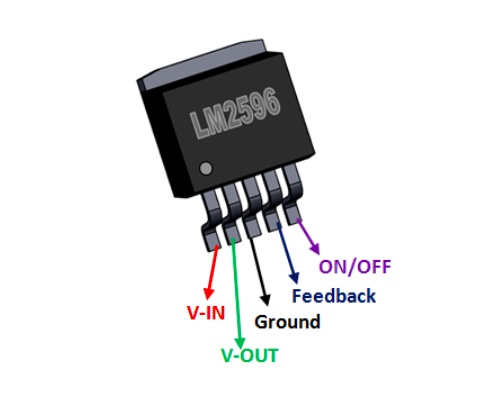
On ready-made modules, the terminals are typically labeled:
- IN+
- IN-
- OUT+
- OUT-
How the LM2596 Works
The LM2596 operates using high-frequency switching at approximately 150 kHz.
Its working process involves:
- The internal switch rapidly turns ON and OFF.
- Energy is stored in the inductor.
- The Schottky diode conducts when the switch turns OFF.
- Capacitors filter the output.
- The feedback circuit continuously adjusts the switching duty cycle to maintain a constant 5V output.
This process results in significantly higher efficiency compared to linear regulators.
LM2596 vs 7805 Voltage Regulator
| Feature | LM2596 | 7805 |
|---|---|---|
| Efficiency | Up to 92% | 40–60% |
| Maximum Current | 3A | 1A |
| Heat Generation | Low | High |
| Input Voltage | Up to 40V | Limited |
| Cooling Required | Rarely | Often |
| Battery Life | Longer | Shorter |
Circuit Diagram
The circuit shown is a 5V fixed-output buck converter based on the LM2596S-5.0 switching voltage regulator, designed to efficiently convert a higher DC input voltage (typically 7V to 40V) into a stable 5V DC output. The input voltage is applied to the VIN terminal, where the 330 µF input capacitor (C1) filters noise and voltage fluctuations before supplying power to the LM2596 IC. Inside the regulator, an internal high-speed switching transistor operates at approximately 150 kHz, rapidly switching the input voltage on and off. The 47 µH inductor (L1) stores energy during the ON cycle and releases it during the OFF cycle, while the SS34 Schottky diode (D1) provides a current path when the internal switch is off, ensuring continuous current flow and improving overall efficiency.
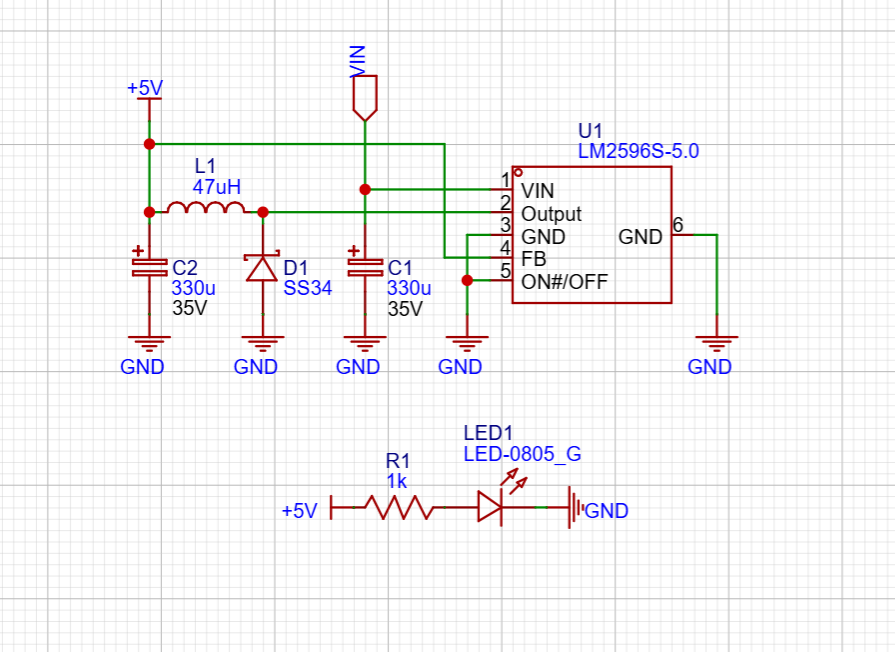
The output stage consists of a 330 µF capacitor (C2) that smooths the switching pulses into a clean and stable 5V output with minimal ripple, making it suitable for powering microcontrollers, sensors, and other electronic devices. The ON/OFF pin of the LM2596 is connected to ground, keeping the regulator permanently enabled. Additionally, a green LED (LED1) connected in series with a 1 kΩ resistor (R1) acts as a power indicator, illuminating whenever the 5V output is available. Thanks to its high efficiency of up to 92%, low heat generation, and ability to deliver output currents of up to 3A, this LM2596 buck converter circuit is widely used in Arduino projects, IoT devices, robotics, automotive electronics, and portable power supply applications.
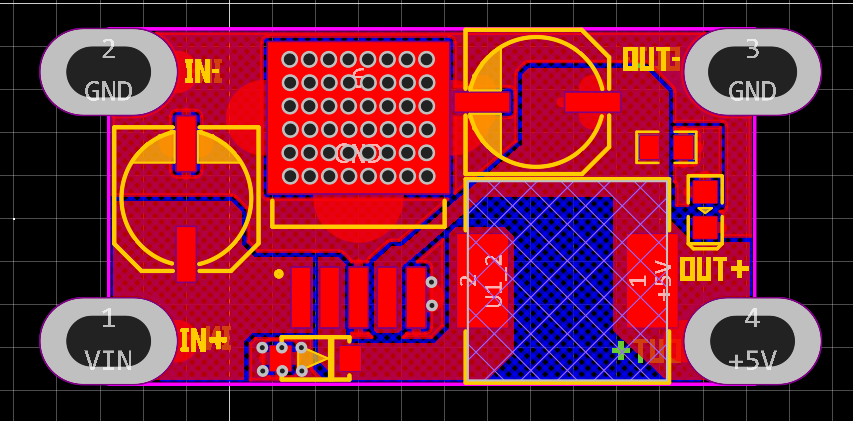
PCB Files
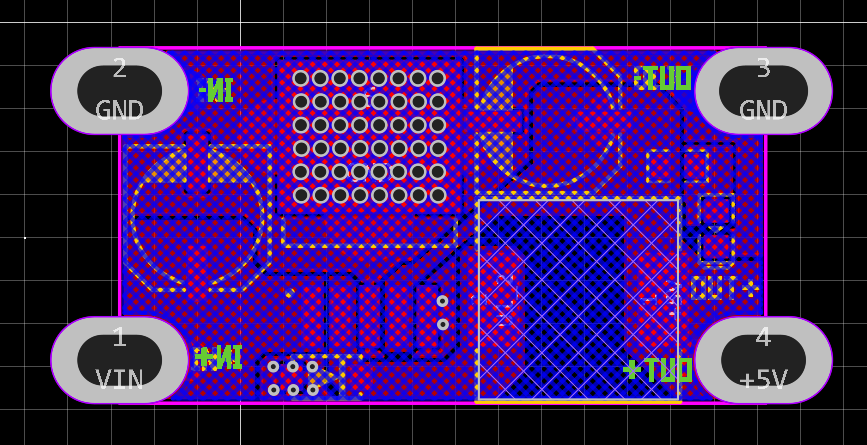
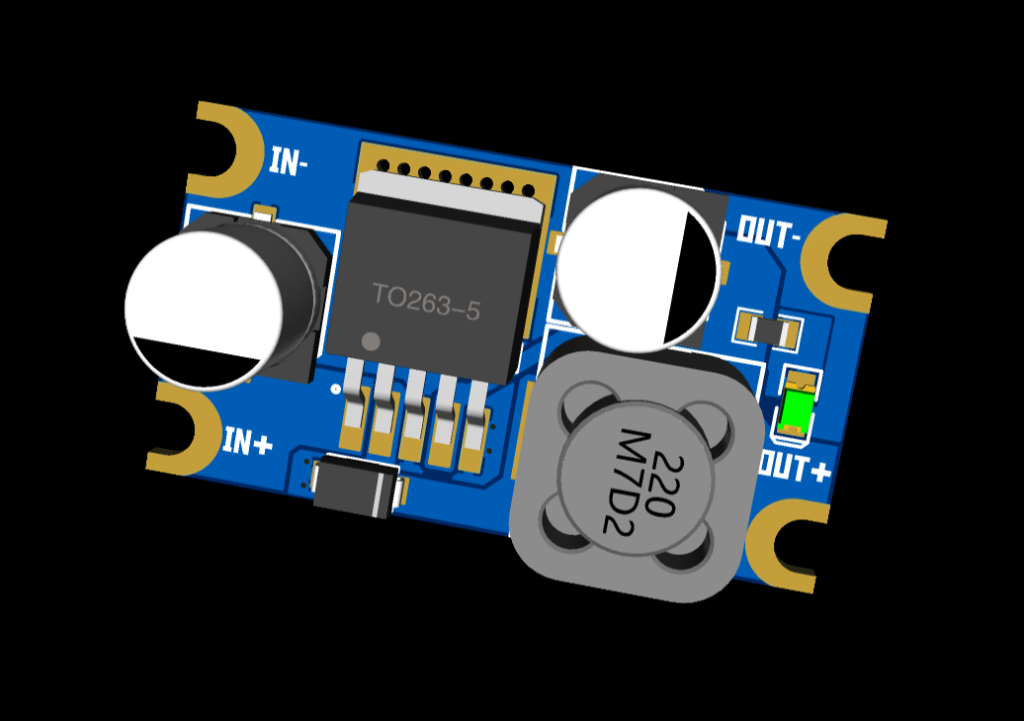
3D Files
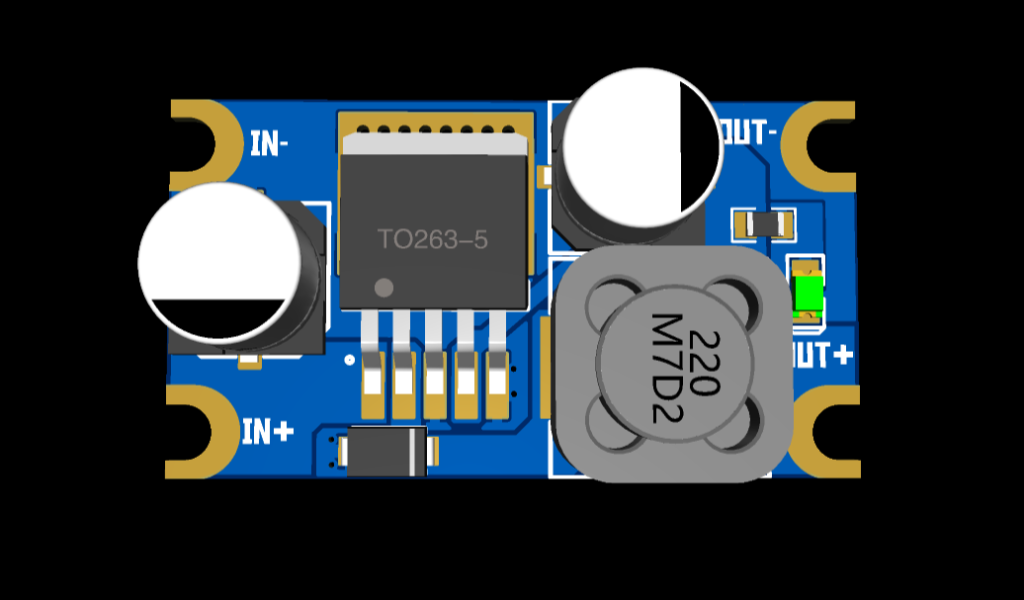
Manufacturing Files
Gerber
BOM
Pick And Place File
Order Directly from PCB WAY
I have already uploaded all these required manufacturing files in PCBWAY website. You can easily go to the below link and place you order, and get your Own Home Automation PCB manufactured from one of the best pcb manufacturer PCBWAY
Frequently Asked Questions (FAQ)
Is LM2596 better than a 7805?
Yes. The LM2596 is far more efficient, generates less heat, and supports higher output current than the 7805.
Can LM2596 provide 5V?
Yes. It is commonly configured to provide a stable regulated 5V output for electronic circuits.
What is the maximum current of the LM2596?
The module can deliver up to 3A under suitable operating conditions, though sustained high-current operation may require adequate cooling.
Can I power an Arduino using LM2596?
Yes. It is widely used to convert 12V or 24V DC into a regulated 5V supply suitable for Arduino boards and other microcontrollers.
Is LM2596 suitable for battery-powered projects?
Yes. Its high efficiency helps extend battery life compared to linear voltage regulators.
Conclusion
The LM2596 5V Buck Converter is one of the best choices for efficient DC voltage regulation. With support for input voltages from 4V to 40V, output currents up to 3A, and efficiencies approaching 92%, it is well suited for hobbyists, students, and professionals alike. Whether you’re powering an Arduino, ESP32, robotics project, or custom embedded system, the LM2596 provides a compact, reliable, and energy-efficient solution.
Numerical Calculator
Best free online calculators for engineers, students and everyday life — from Ohm’s Law, LED resistors and RLC resonance to BMI, calories, pregnancy due dates and EV savings — each with live diagrams and step-by-step math.
Numerical calculator : https://numericalcalculator.com/